My
Dream of Asaph Hall
A dream that
came true in 2003.
When I was a wee lad someone--I'm no longer
sure who--noted my fledgling interest in astronomy and bought me some books. One
of these books became my guide to astronomy as a science (Introduction to
Astronomy by Cecila Payne-Gaposhkin). The other became my guide to practical
observing (The Telescope Handbook and Star Atlas by Neale E. Howard). And
so began my lifelong journey with one foot firmly planted in the science of
astronomy and the other equally planted in amateur observing.
I read Howard's book from cover to cover many times. I learned about
different types of telescopes, mounts, eyepieces, and the observation of various
objects. The section entitled "The Martian Moons" particularly caught
my fancy:
"Certainly the strangest little
objects in the whole solar system, the two moons of Mars will rarely be seen
by the amateur unless he possesses a 16-inch telescope, and then only at
favorable oppositions."
I never imagined owning a 16-inch telescope at
the time. It was something so large and expensive that such a thing never
entered my head. Instead, in my mind's eye I imagined what Asaph Hall has seen
when he discovered Deimos on August 12, 1877; I saw a speck of light in the
glare of the planet and felt his jubilation.
I first had a half-hearted try at observing the moons of Mars in the late 70's
using my newly acquired 6" f/8 Meade Newtonian. Of course, I knew from my
reading that such a small telescope should not reveal them. Not a real
confidence builder, that. But I was also far too inexperienced.
I tried again at many later oppositions, using different telescopes, but never
really putting in any serious effort. Having moved to Cloudcroft, New Mexico in
1998, where the sky is clear and dark, for the first time I put some serious
effort into detecting the moons using the only telescope I still had access
to--that same old 6-inch. But to no avail. At least that time it wasn't from
lack of trying.
During the 2001 opposition I added another distinct advantage. Not only was I in
Cloudcroft, but I had my newly completed home-crafted 18-inch Dob. Unfortunately
Mars was low in the sky and the weather horrible. In order to see it over the
trees in my yard I had to go to great lengths (literally) and the position of
the telescope was good for little else. I went so far as to make an occulting
bar that time, but still came up empty. The dreams of Asaph Hall faded once
again.
Somewhere in there I wrote an article about observing the moons of Mars for my
web site. The most recent incarnation was originally posted at the beginning of
August, 2003. I didn't really realize until one wonderful morning just how flat
and uninteresting that article was.
As August 2003 wore on our monsoon season was in full swing. Clouds built all
day and it wasn't possible to predict if it would be clear or raining cats and
dogs at any time during the night. Even the Clear Sky Clocks, which are
usually spot on, had been useless. When it cleared late it hadn't been practical
to take my 18-inch out due to sleeping kids and cool down time. So I'd been
taking my old familiar 6-inch out instead. It gave me some pretty good views of
the planet, although not nearly as often as I'd have preferred..
On the night of August 19/20 I hauled the old girl out around midnight. After a
struggle I was about 75% sure that I had finally glimpsed Deimos. If I had, I
guess it was pretty fitting that it happened in the old scope. That afternoon I
read a message from Russ Lederman describing his view of Phobos and Deimos in
his 20 inch where he saw both moons without all that much difficulty and with
Mars in full view. That was a confidence builder.
The next night (August 20/21) the weather pattern changed. It looked like a
little high pressure area--of all things--had built around my location during
the late afternoon. With much better weather I was confident enough to bring out
Skyhound (my 18-inch) at dusk. I collimated it, started the fan, then
went indoors and carefully cleaned my eyepieces. I knew mars would first rise
above the trees just before midnight. No deep sky observing this night; I had
other things on my mind: two of them.
At around midnight I finally set out, feeling a little like a soldier on a
mission. I had a good idea this was going to be the night. Mars was so bright
that it dominated the night, much as it had dominated my observing thoughts that
month.
I didn't fool around, putting in what has become my "goto" eyepiece:
my 8mm Radian. Compared to the previous night's view in the 6-inch I was at
first overwhelmed by the brightness of Mars and all the scattered light
surrounding it. I remember thinking that there was no way I'd be able to make
out two faint specks in all that glare. Phobos was nearing elongation so I
concentrated on the eastern side of the planet, about one Mars diameter away
from the edge of the disk. Nothing. I took a deep breath and decided to enjoy
Mars itself for a while. The seeing suddenly improved and I was trying to tease
more detail out of the southern features. In all of this I only slowly realized
that I was seeing a tiny speck of light to the east of the planet. I turned my
attention to it and it disappeared. Moving my eye up and away a bit it came back
into view and I was able to hold it plainly visible. Phobos! I let out the
customary "Oh... my... god!" and felt the strain on the skin around my
eye from the big grin I was wearing.
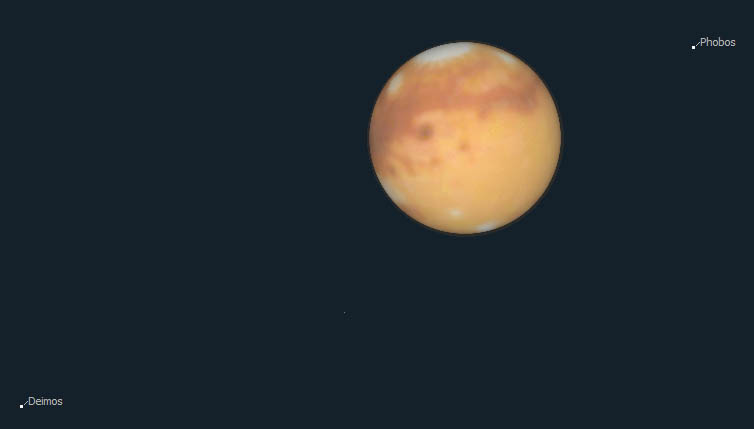
It was sort of an emotional moment--a huge wave of serene satisfaction. Sure,
just about anyone could probably see Phobos in a well designed 18-inch scope
with the right eyepiece from Cloudcroft New Mexico at 9000ft on a night of good
seeing during the most favorable opposition. But none of those things just
happened; I didn't arrive at this time and place by chance. It was the result of
hundreds of conscious choices; choices that I had made. Standing there by the
scope looking up at bright old Mars, well, it was a moment--a private, personal,
moment. This victory gave me pause to think about who I am and and about the
long journey that brought me to this time and place, and to the realization of
how lucky and contented I am.
Back at the eyepiece I found Phobos to be easy to spot; every time I looked,
there it was shining away. I finally tracked down Deimos way off to the west of
the planet. I found it the more difficult of the two, mostly because it was way
out there in no man's land where there were few guideposts to get to it.
Comparatively, Phobos was right there just off the equator of the planet. Phobos
gave the appearance of a larger, more turbulent dot, powering through the bright
glare, while Deimos appeared more as a tiny faint speck lost in a sea of haze.
I soon came to the point where I could spot each moon easily, requiring only a
short eye movement between the two. They were too far apart to see
simultaneously, but after a while I had the same impression one would have
observing Saturn--ho mum, there are those pesky little moons, always hanging
about.
I thought of my "observing the moons of mars" web page and suddenly
realized that I had an opportunity to do some experimentation that could
possibly help others looking to see these two illusive objects. I tried many
things: different eyepieces, a Barlow, occulting bar, Mars off the edge, etc.
Don't think this is for 16-inch scopes only! I would not be
surprised if Deimos could be glimpsed in a 4-inch under just the right
conditions. Unfortunately it won't be until
2014 that Mars is again large enough to try in smaller instruments.
Other
articles about mars:
Observing
the moons of mars
Observing
mars in 2010
|
